Monday, January 21, 2019

Promises, Promises

PROMISES, PROMISES
by Jessica Ferguson

Several months ago, I read a novel—women’s fiction—that I can’t get out of my head. I didn’t like the main character or her parents. Her best friend was annoying so I didn’t like her either. Her kids were brats—one was whiny and the other was hateful. I have no idea why the main character stayed with her husband for 20+ years, so I’m glad he was deceased and I didn’t have to deal with him. Her memories of him were enough.

Are you wondering why I kept reading? The writing was great, even though the story was slow moving with sad, painful characters. Only one character captured my interest, and he showed up near the end of the book. He was a quirky university professor that dressed weird and—at the most—appeared in four short scenes. He wasn’t much more than a walk-on with interesting dialogue, but he infused hope and energy into the story, and saved the book for me. By the time I read the last page, that novel felt like the most wonderful love story I’d ever read ... not because it WAS a love story, but because it was going to BE a love story—after I closed the book and went on my merry way. Some pithy dialogue and the sweet promise of a cup of coffee captured my imagination.

Interesting how the perfect ending—the perfect promise—can save a story, and leave the reader feeling so amazingly satisfied!

And the opposite is true too.

I came across a nonfiction book on creativity that yanked me in the moment I read the title. There was such promise and encouragement on those pages. I couldn’t put the book down. I read every paragraph with a yellow highlighter, knowing there were key observations I’d want to revisit. I texted my daughter daily to tell her how wonderful the book was. Two or three chapters from the end, I noticed a change in tone, and the focus of the book shifted. It was almost as if the final chapters had been written by someone else. In the last chapter, the author devoted himself to insulting me as a Christian reader/writer/creative. He told me my interpretation of the Bible and Heaven was wrong. Pardon me?

Where was the wrap-up on being creative? The encouragement I expected? My sigh of satisfaction? Had I been blind during the first 30 something chapters? He ruined the entire book for me. I can’t remember one positive thing in previous chapters.

Whether we write fiction or nonfiction, we make a promise to our readers in each story we write. Be certain what that promise is and make sure to deliver on it. Whether we’re indie or traditionally published, the old saying, “The first page sells your book and the last page sells your next book” is truer than we realize.


Jessica Ferguson is the author of The Little Girl in the Bayou, a short story included in the Tick Tock—A Stitch in Crime anthology published by Dancing Lemur Press.  A Former staff writer for Southern Writers Magazine, Jess also worked as assistant editor/writer/photographer for The Times of Southwest Louisiana. When rights to her novel and novellas were re-assigned to her, Jess had every intention to revise and republish. A search on Amazon will show you that procrastination gets you nowhere. 

Website
Instagram: @jessyferguson
Twitter: @jessyferguson
Facebook: Jessica Ferguson
WEBSITE

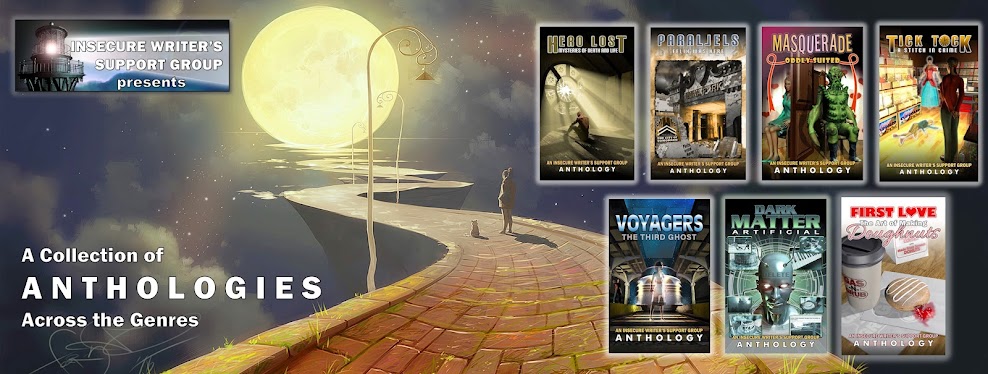
Tick Tock: A Stitch In Crime
The Little Girl in the Bayou by J.R. Ferguson

Thursday, January 3, 2019

Congratulations! #IWSG #Anthology


IWSG Anthology Contest Winners
The big moment everyone has been waiting for – the announcement of the IWSG winners. Here are the stories and authors that have been selected for our fourth anthology:
Oddly Suited by LG Keltner
Sea of Sorrows by AV Brown
Behind the Catcher’s Mask by Jennifer Lane
A Diver’s Ball by Angela Brown
Fearless Heart by Deborah Solice
The Dark Charade by CD Gallant-King
The Cog Prince by Elizabeth Mueller
Flower of Ronda by Myles Christensen
Remedy by Chelsea Ballard
Charleston Masquerade by Carrie-Anne Brownian
The top story has the honors of being included in the title. LG Keltner’s story came out on top! The official title of our next anthology – Masquerade: Oddly Suited. Congratulations, LG. (She was also in the top spot for our first anthology, Parallels: Felix Was Here.)
The IWSG Admins spent many hours reading the entries and fourteen were sent to our special judges. We certainly wish to thank them for taking time away from their own work to read the entries:
Elizabeth S. Craig, author
Kelly Van Sant, agent at Red Sofa Literary Agency
Elana Johnson, author
DL Hammons, Write Club founder
S.A. Larsen, author
Kristin Smith, author
Gwen Gardner, author and previous IWSG anthology winner
Look for Masquerade: Oddly Suited late spring!

Wednesday, December 5, 2018

How to #Win a #ShortStory Contest!

How to Win a Spot in the IWSG Anthology Contest
by Gwen Gardner

I’m always impressed by the quality of writing in the Insecure Writers Support Group anthologies. To me, it’s a prestigious compilation of stories by respected members of this growing community of writers. When I won top spot in the third anthology, Tick Tock: A Stitch in Crime, I was sure someone made a mistake. I mean, I write cozy mysteries. Cozies are gentle reads. They are clean, low key, and low action. Any violence happens off stage and sex is never mentioned.

So how did a cozy mystery story win the top spot in the anthology? First, I went back to the basics that every writer knows: hook, strong verbs and dialogue, quirky characters with flaws, a grounded setting, show rather than tell, and edit, edit, edit. We all know the drill.

I always knew the competition was tough. That much was apparent once I’d read all the stories in Tick Tock. But now that I’m a judge of the next IWSG anthology, it’s become even more apparent. The margin of excellence is so narrow between the remaining competitors that it’s nearly impossible to choose a favorite. As a judge, how do I pick my top three favorites when they all deserve to win? What is that extra something you can do that gives you the winning edge?

Go back to the guidelines:
  1. Keep your eye on the theme and genre. In Tick Tock: A Stitch in Crime, the theme was time/clock and the genre mystery/crime/thriller. When I won, the title I submitted to the contest was, A Stitch in Crime. It’s a play on the old saying, “A Stitch in Time”. So you can see I used both the time theme (through a play on words) and the genre (crime) in the title.
  2. Continue the theme throughout your story. In my story, time was running short to reunite a little girl with the nun who raised her.
  3. Come full circle by tying the ending of the story to the beginning. In the beginning of my story, my main character was learning how to cross-stitch. Towards the end of the story, a cross-stitch panel ends up being the clue that solves the mystery.
I hope these tips help. For myself, I continue to study the writing craft, and I’m always reminding myself of the basics. Over on my Pinterest page, I have over 2000 pins separated into 37 different sections that are chock full of everything writing related, from inspirational quotes by famous authors to detailed how-tos on the craft. Check it out!

How do you stay up on the writing craft?
Any tips or tricks you use?


Gwen Gardner’s story, A Stitch in Crime, won the feature spot in the IWSG Anthology #3. She writes clean, cozy, lighthearted mysteries with a strong ghostly element. Since ghosts feature prominently in her books, she has a secret desire to meet one face to face – but will run screaming for the hills if she ever does.

She thinks there’s nothing better than a good mystery (being an excellent armchair detective herself), unless it’s throwing a ghost or two into the mix just to “liven” things up. Don’t worry, though. Ghosts may be difficult to keep in line, but they’re harmless—mostly. And it turns out they’re pretty good sleuths, too.

Gwen adores travel and experiencing the cultures and foods of different countries. She is always up for an adventure and anything involving chocolate – not necessarily in that order.