Showing posts with label IWSG Anthology Contest. Show all posts

Wednesday, December 1, 2021

How it Started vs How it's Going

It's Insecure Writer's Support Group Day again, and for this first Wednesday of the month--the last one of the 2021 year--we have a reflection wrap-up post from the IWSG Dark Matter contest winner. Stephanie Espinoza Villamor shares her thoughts about the contest one year later and how far everything has come:

I can hardly believe it's been over a year and a half since I first started drafting "Artificial," the title story in Dark Matter: Artificial and contest winner for the Insecure Writer's Support Group 2020 science fiction anthology contest. I remember reading the prompt, "dark matter" with so much uncertainty. I remember opening up a Google Doc titled "Sci-Fi Short Story #1" in April 2020 after my then 10-month-old nursed to sleep. The document and the title changed over the course of several months before the content deadline. In May 2020 the story was going to be called "The Archive." In June 2020 it switched to "Sci-Fi Story - AI" (and then it really began to take off). In July 2020 my title ideas included "What an AI is For," or "Something Real" or "Building a Memory." Finally I was down to "Artificial Memory" and finally, "Artificial." I'm so glad I settled on this title when I submitted the story on August 11 to ensure receipt before the September 2 deadline. The publisher herself said my title fit with the main title very well so it was perfect as a subtitle.

I was just in shock to have actually won that honor.

This was how it started. As the year comes to an end and a new anthology gets ready to take our place with the Sweet Romance: First Love contest nearly complete, I can reflect on my entire contest experience from start to finish. Around this time last year I had only just found out I would be published in the anthology--my first major publication outside of some local magazine/short story collections. Though the news was still under wraps, I was starting to learn about contracts and get ideas for marketing. Soon I would get to virtually meet the other winning authors over email and through this blog. I was so excited for the day I received an advanced ebook copy so I could read their winning stories as well!

How has the contest changed me? I don't know if I feel less "insecure", but I am more likely to call myself a "published author." I think, more than anything, I do feel "secure" enough to write outside my comfort zone. Growing up writing fantasy and contemporary school stories,  I never thought I would be any good at science fiction. Now I've had two science fiction short stories published with ideas for several more. I even tried my hand at writing a supernatural story! I'm not typically a fan of "scary" stories, but suddenly I was willing to try a few ideas. While I didn't participate in the Sweet Romance: First Love contest, I've been thinking about ideas for sweet romances that are less common/mainstream, and certainly nothing I've ever written before. There's newfound confidence but also a willingness to take more risks with my writing before. Because they might pay off in ways I never thought possible.

I've now learned how to market through social media. I've presented at an international speculative fiction convention. I've submitted my work to more contests than I ever would have dared and I even applied for a creative activities award that's offered in my state. But even if these endeavors don't lead to publications, they motivate me to keep writing. To me that's the best part of all. You can't get your work out there if you don't have any work. You can't draft and edit if there's no draft. To be a writer the only real requirement is to write. And this contest experience has not only been a fun adventure but it's inspired me to continue the writing that I've always loved, even when life gets busy. Even when you have a baby (or one on the way...). It's worth it to keep writing in your life. When you have a full-time job, a family, and so many responsibilities, it's important to have at least one special thing that's just for yourself. Writing is that for me.

How is it going? Well, since 2021 led up to the publication of Dark Matter: Artificial in May, I've mostly been focused on marketing and spreading the word. I've been practicing using professional social media, organizing these blog posts, and trying to get some book signings in local stores. Unfortunately the pandemic affects us all and many potential in-person events were cancelled again when the COVID-19 Delta variant started surging in our area. But as this year comes to a close, my plan is to get back to writing more (at least until my second son arrives in January). I'm also awaiting the news of another anthology contest (I'm still in the running since I didn't receive the initial rejection email!) and the publication of a non-fiction book I co-wrote about my "day job", due out in June 2022 (Practical Marketing for the Academic Library)!

I also just found out on November 22 that I won the creative award I applied for! The award recognizes significant accomplishments that bring recognition to our local institutions in the state. I couldn't be more honored. It's such an exciting way to encapsulate this year and show how much my writing has grown.

I'm grateful to everyone who has been a part of this anthology experience. To publisher L. Diane Wolfe, IWSG founder Alex J. Cavanaugh, and all the judges for the 2020 science fiction anthology contest. To my fellow authors who are amazing writers that I am in awe to be published beside: C.D., Kim, Steph, Tara, Deniz, Charles, Olga, Elizabeth, and Mark. Thank you especially to Tara Tyler and Louise Barbour for their help with this wonderful blog process!

And a personal thank you to my writing group friends: Beth Schuck (published in the IWSG anthology Voyagers: The Third Ghost), Theri, Michelle, Abriana, Rebecca, and Jen who read my stories and are always been so supportive and helpful. If you can join a writing group to read and critique your work, I can't tell you how valuable that is in terms of improving what you write as well as lifting you up right when you need it.

Additional shout outs to my family: my parents, brothers, in-laws, husband, and son all inspire, help, and support me in ways that allow me to write and encourage me to keep going. And while I haven't met him yet, I'm excited for my current WIP: Baby #2!

I hope this post inspires others to continue their own writing journeys knowing that it is possible to meet your goals and that there can be payoff at any time, any step along the way. There is no "end" with being a writer--no one task that you have to accomplish to have officially "made it." You just keep going and keep enjoying your achievements--big and small--along the way.
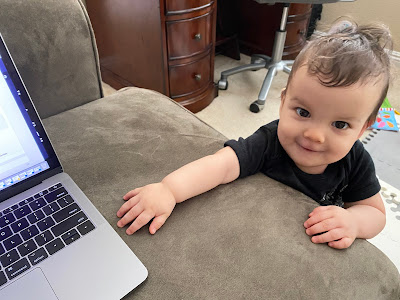

How it started: April 2020, working from home during the pandemic
and writing while my 10-month-old sleeps (not always easy!)

How it's going: 2021, published with a 2-year-old! 
One book on the way (due June 2022)
and one baby on the way (due January 2022)!

If you still haven't checked out Dark Matter: Artificial and want to know what our authors have been talking about, we encourage you to pick up your copy today (and just in time for the holidays too if you're looking for a unique gift for the readers in your life)! The science fiction anthology is on sale on Amazon right now, and can be found through Barnes and Noble, Kobo, and our publisher: Dancing Lemur Press. Happy Writing and Happy Reading!

Wednesday, September 1, 2021

Contest Deadline!

It's deadline day! If you haven't entered the Insecure Writer's Support Group 2021 Annual Anthology Contest, today's the last day (September 1, 2021)! If you're polishing up your manuscript, be sure to get it in by today as a formatted Word file to admin@insecurewriterssupportgroup.com. The genre this year is Sweet Romance and the theme this year is First Love. More details can be found on the Insecure Writer's Support Group website.

The authors of Dark Matter: Artificial sure know what it's like to work up against a deadline. We've all been through it in order to submit our stories for last year's anthology! What was the process like? A few authors share their experiences below.

Stephanie Espinoza Villamor: It took me a while for my IWSG anthology idea to fully form. Once I had "the one" story idea I was excited to write about, I just had to make the time to write (usually while my young son was asleep) in order to make the deadline. When I try to write a novel, I often don't know exactly how the story will turn out. But when I write a short story, I usually have the ending in mind and it's all about getting to that ending in a logical way where everything introduced in the story is "paid off" or resolved. Once I've made it to the end I...rejoice! And then prepare for editing. I typically show my stories to a small group of friends in two different critique groups, ask for feedback (Google Docs is helpful for this), and then start the rewrites until the manuscript draft feels as strong as possible--usually a week or two before the deadline (sometimes a day or two before the deadline!). I don't like to submit at the very last minute just in case something goes wrong, although I've done that a couple times in grad school....

Tara Tyler: When I hear the IWSG topic, I either immediately think of a story or I just don't feel it. Like this year's contest, I started but couldn't feel it, so I dropped it. Since I have more time in the summer to write, I usually at least put together an outline. Once I start the first draft, the flow of it tells me if I'll be able to make the deadline. I actually like deadlines--they motivate me! The word count is where I struggle sometimes. If my word count gets too long, I have trouble cutting away words while trying to keep the soul of the story vibrant.

Deniz Bevin: All of my recent short stories seem to happen the same way: I get an idea (usually in the summertime!) and have to write down the entire story right away before I lose it. This is how my anthology story came to me. I've had other stories I've entered over the years in the various anthology contests but I don't think those other ones fit quite as well into the theme or the tone of the collection. After I've written the story in my mad rush, I type it up (if it was written on paper) and complete one or two rounds of edits before sending it out to beta readers. Then another round or two of editing, and yet one more if I've decided to submit it somewhere. There's always something to tweak...
One of the best parts of the IWSG Anthology process has been seeing the story published and finally being able to call it done!

Olga Godim: I always try to have sufficient time when I write fiction to a deadline. Never do it at the last minute. Fiction needs editing, at least two rounds for a short story. And I would never send an unedited entry to a competition. So I plan in advance, with plenty of time built-in, and usually submit my story days or even weeks before the deadline.

Elizabeth Mueller: I rather enjoyed my experiences writing for the IWSG. I start off mulling over the theme and listen for the mood that I want to come across: Do I want it to feel scary? mysterious? mournful? adventurous? After stewing over it for a while, I sit down, pray for inspiration, creativity,  and motivation. I finish it in one sitting before I get back to it for editing before creating the query letter for submission: the most challenging part sometimes is crafting a clever summary!


Speaking of short story anthologies, the Insecure Writer's Support Group book club is reading two of the IWSG anthologies in the month of September: Tick Tock: A Stitch in Crime and Parallels: Felix Was Here. Chcck out the IWSG book club on Good Reads! (https://www.goodreads.com/group/show/214387-the-insecure-writer-s-support-group-book-club).


Learn more about IWSG at: https://www.insecurewriterssupportgroup.com/. It's been exciting being a part of one of their anthologies and we look forward to seeing what the next anthology will bring!

Friday, June 4, 2021

The Next Best Thing

Can you believe it's already time to collect stories for the NEXT IWSG ANTHOLOGY CONTEST? Well, here it is. And it looks like a brand new world of fun...

The Seventh Annual IWSG Anthology Contest!

Guidelines and rules:

Word count: 5000-6000

Genre: Sweet Romance

Theme: First Love

Submissions accepted: 
May 7 - September 1, 2021

How to enter: Send your polished, formatted (double-spaced, no footers or headers), previously unpublished story to admin @ insecurewriterssupportgroup.com before the deadline passes. Please include your full contact details, your social links, and if you are part of the Blogging, Facebook, Instagram, or Twitter IWSG group. You must belong to at least one aspect of the IWSG to enter.

Judging: The IWSG admins will create a shortlist of the best stories. The shortlist will then be sent to our official judges.

So, do you think this genre is up your alley? Are your writing wheels spinning with ideas? Go for it! It's a blast!

Wednesday, May 26, 2021

In the Spotlight: Mark Alpert ~ Author of "Vera's Last Voyage"

Today we spotlight our final author from Dark Matter: Artificial! We've asked him to share a little about how he came up with his story and preview what's to come!

Mark Alpert on his short story, "Vera's Last Voyage."


I’m a journalist as well as a novelist, and many of my journalism colleagues become very amused when they discover that I majored in astrophysics in college. An Associated Press photographer once took me aside and said, “Listen, your new nickname is Astro, okay? Because that’s what all of us have been calling you ever since we found out.”


I chose to study astrophysics at Princeton University because I thought it was the most poetic of the sciences. It explores and explains some of the most beautiful objects in the universe, the stars and planets and nebulae and galaxies that still fill me with wonder whenever I gaze at the night sky. Even more romantic, astrophysics is full of mysteries. Is the universe infinite? Did it have a beginning? Why are its laws mathematical, and do they have a purpose? Why is there something instead of nothing?


Dark matter was one of the great mysteries confronting astrophysicists in the 1980s when I was at Princeton. Just a decade before, astronomer Vera Rubin had painstakingly observed the rotation rates of dozens of galaxies, which were spinning much faster than anyone had thought possible. The best explanation, Rubin concluded, was that each galaxy was embedded in a huge cloud of invisible matter that vastly outweighed all of the galaxy’s stars, gas, and dust. But despite a half-century of diligent searching since then, astronomers have failed to detect even a smidgeon of this dark matter. Mysterious, right?


When I started writing novels fifteen years ago, I focused on scientific mysteries. Albert Einstein, the enigmatic founder of modern physics, was the subject of my internationally bestselling first novel, Final Theory, which was published by Simon & Schuster in 2008, optioned for film, and translated into two dozen languages. My third novel, Extinction (St. Martin’s Press, 2013), scrutinized the mystery of consciousness, while my ninth novel, The Coming Storm (St. Martin’s, 2019), explored the puzzles of climate change and genetic engineering. So, it was a special pleasure for me to return to the mystery of dark matter by writing a short story for this anthology.


Vera Rubin died in 2016 at an assisted-living facility in Princeton, N.J. I thought it would be interesting to imagine her still wrestling with the dark matter problem at the end of her life, so that’s the premise of my story. In her last hours Vera envisions the entire history of the universe, stretching ahead to the far future, and she compares dark matter to God. Dark matter, like many common conceptions of God, is ubiquitous and played a vital role in creating the universe as we know it. What’s more, we haven’t been able to directly detect dark matter, and yet we sense its gravitational presence. It’s an interesting comparison, but I can’t really take credit for it; the Vera Rubin character inside my head explained the idea to me, and I just wrote it down. Thank you, Vera!


Mark strikes a Sea Hunt pose during a scuba expedition
near Heron Island in Australia’s Great Barrier Reef.

Mark at a book signing for The Siege, one of his
Young Adult novels, at Books of Wonder in NYC.

Mark reenacting the murder made famous in Anatomy of a Murder 
at the Lumberjack Tavern in Big Bay, Michigan.

Mark is hard at work on his next novel! Go to www.markalpert.com 
to see excerpts and buy links for all his books.


Blurb: 


Mark Alpert’s short story, “Vera’s Last Voyage,” imagines the final moments in the life of the late Vera Rubin, the brilliant astronomer who discovered the best evidence for dark matter but never got the full credit she deserved, partly because of sexism.


Excerpt:


I turn back to the elliptical galaxy. Bob has evidently ratcheted up the pace of cosmic history, and now quadrillions of years are zipping by in an instant. All the white dwarf stars have cooled into black dwarfs, charred cinders of high-density matter, utterly frigid and dead. All the largest stars have collapsed and become black holes, which revolve unseen around the monstrous hole at the galaxy’s center. The only fireworks happen when two stellar remnants collide and spark a supernova, or when two black holes get too close to each other and merge with a spacetime-shaking clang. But those collisions occur less and less often as time goes on. For untold eons, the universe does nothing exciting. It’s dark and silent and very, very boring.


Thinking about it makes me shudder. If the universe were a person, it would spend just a tiny fraction of a second going through all the active phases of life—childhood, adolescence, adulthood, the golden years. And then it would spend billions of millennia lying on a bed in an assisted-living facility, doing nothing at all. Why does it take so long to die?


Mark Alpert is the internationally bestselling author of 10 science fiction novels. He first heard about dark matter while studying astrophysics at Princeton University, and he learned much more about the subject while working as an editor at Scientific American during the 1990s and 200s. His first novel, Final Theory (Simon & Shuster, 2008), was published in 24 languages, optioned for film, and condensed for Reader's Digest. His Young Adult novel, The Six (Sourcebooks, 2015), was nominated for the Nutmeg, Beehive, and Cybils awards. His tenth and latest novel is Saint Joan of New York: A Novel About God and String Theory. Learn more at: http://www.markalpert.com/


Wednesday, May 12, 2021

In the Spotlight: Elizabeth Mueller ~ Author of "Resurgence"

First off, we must announce that our IWSG anthology blog tour has continued throughout early May with some fun interviews from our authors, hosted by fantastic bloggers in the IWSG community.

Check out Ellen Jacobson's blog as she interviews Stephanie Espinoza Villamor, author of the winning story entry.

Mason Canyon's Thoughts in Progress blog has guest posts from authors Charles Kowalski, C.D. Gallant-King, and Tara Tyler. 


Louise Barbour's Standing Into Danger blog features interviews from all the authors about how they got into science fiction. Louise was also published in the previous anthology, Voyagers: The Third Ghost!


Next we have author C.D. Gallant-King who will be featured on Nick Wilford's blog and a short pitch for the anthology stories from all authors on Cathrina Constantine's blog.


And now, we're on to our continued posting from each of the contributing authors in Dark Matter: Artificial. We've asked them to share a little about how they came up with their stories and preview what's to come!

Elizabeth Mueller on her short story, "Resurgence."

This is super exciting that the IWSG team enjoyed my story! You can imagine my surprise. My usual genre is anything with romance. What can I say? I’m a romantic. Because of that, I didn’t expect to write sci-fi until I saw the theme—dark matter. How intriguing. How can I resist that? We can go anywhere with this.

Being a stay-at-home mom has given me the ability to explore different genres. I started my early years writing about talking horses before going to high fantasy. I do love elves, dragons, shape-shifters, and goblins. Then there’s witches in covens and soul-sucking demons to Greek gods and Norse gods. I eventually changed over to the French Renaissance and modern rock stars. Then there’s high school football players and cheerleaders! I eventually plan to go back to high fantasy but I’m not sure about talking horses. I realize that it sounds like there’s no passage of time between the above genres but this has been ongoing for the past thirty-plus years.

As for sci-fi, I’m relatively new but after some research regarding dark matter, my imagination soared. I wanted to write something fast-paced and exciting. Something that contains unpredictability as well as shock factor—think The Twilight Zone.

“Resurgence” tests the avenue of what-ifs regarding humanity’s survival.

Blurb:

Keeping his nightmares secret is costing Damarin his sanity and encountering strange anomalies might damage his reputation. Is uncovering dark secrets worth the risk?
 
Excerpt:

Damarin eased from the bed, vigilant of waking Zarynah. Wisps from his nightmare trailed him into the lavatory.

“Lumens,” he said with a hoarse tone, his eyes weighted. The ambient spheres flared into life, illuminating the darkened chamber. He leaned over the basin, his fingers clenching the rounded edge. The ground spun beneath his toes. He refocused on his disheveled reflection.
 
The strident howls haunted him within the confines of his skull along with the unsettling image of the rusted sky. He perceived faces. The faces stared back at him with silvery, unblinking orbs. They sought his flesh with ravenous howls.
 
He inhaled sharply and reeled back, his bare feet finding traction with the polished nickel flooring.
 
“I can’t,” he gasped, digging the heels of his palms into his eyes until flashing brilliant color shone. He stumbled for the bedchamber and dropped onto the bed with a groan.
 
He sat within the silence, and after his vision adjusted to the dim lighting, he noticed a silhouette before him. The form proved a degree darker than the gloomy monochromatic environment. It tapped away at the air on what looked like a mainframe. It stilled, turned, and locked its startled gaze with Damarin.


Award-winning author Elizabeth Mueller lives deep in the heart Texas surrounded by everyone she loves—including the characters who don’t stop talking in her head. While she enjoys homeschooling her kidlets, she thrives as a full-time writer of any genre that captures her heart.


Coming on Wednesday, May26, 2021 . . . 

Next up will be our final author, Mark Alpert, who shares his backstory for "Vera’s Last Voyage."

Tuesday, May 4, 2021

Dark Matter: Artificial releases today!

We interrupt our regularly scheduled Dark Matter: Artificial author spotlights to let you know that the anthology is officially available today! You can now purchase print or ebook versions of Dark Matter: Artificial from Amazon.com, Barnes and Noble, Kobo, and Dancing Lemur Press.

Our blog tour begins today as well! We hope you enjoy reading our interview answers that give a little insight into the writer mind and are sometimes just plain fun!

Please check our Laura Billings' blog, Bookish Equestrian, for interviews with our authors on how we came up with our ideas (https://bookishequestrian.wixsite.com/).

And Jemi Fraser's blog Just Jemi interviews the authors asking us which fictional world we like best (https://jemifraser.blogspot.com). Fun fact, Jemi's story was published in the Insecure Writer's Support Group anthology, Tick Tock: A Stitch in Crime!

Stay tuned for more blog tour links, and then Elizabeth Mueller's author spotlight here on May 12!


Wednesday, April 28, 2021

In the Spotlight: Olga Godim ~ Author of "Nano Pursuit"

The IWSG Anthology blog will be featuring posts from each of the contributing authors in Dark Matter: Artificial over the next few weeks. We've asked them to share a little about how they came up with their stories and preview what's to come!

Olga Godim on her short story, "Nano Pursuit."

When I decided to write a story specifically for this anthology, the genre wasn’t a problem. I like writing sci-fi stories. But the theme was a huge question mark. What was Dark Matter? I didn’t want it to be some astrophysical feature of the universe. My stories tend to be personal. My characters never save the world; their problems are also personal. So what was Dark Matter for them? 

Then I came up with my all-important definition. It is not a spoiler--the reader would read it on the first page of my story. Dark Matter for my characters is the name of nanobots, the tiny bugs one of my characters invented. They eat plastic and metal garbage.

As soon as I had the definition, I knew that for my story to work, the nanobots have to be stolen. From there, the story unfolded.

Blurb:

Whoever stole Dark Matter from Alexa and her cousin Georgy are despicable thieves, aren’t they? When Alexa catches up with them, she would make them suffer for their felony. Probably. If they are truly guilty.

Excerpt:

A movement in the cave’s dark aperture alerted Alexa. She whirled and fired her stunner at the body hurtling toward her before she even saw her attacker clearly.

The stunner buzzed, and the assailant crumpled with a muted groan. Alexa tip-toed around the nose of the flier, her stunner ready for the second thief, but no more attackers materialized. Her heart pounding, she shuffled toward the downed figure.

It wasn’t a man. It was a girl. A teenager with a mop of dark wavy hair, unconscious on the cave’s floor. 

“Drat!” Alexa spat. “Now, I’m shooting children.” She squirmed in guilt. The security tape of the thieves showed two adult males. Who was this kid? A stunner gun clutched in the girl’s hand alleviated Alexa’s pangs of guilt, but only a little. Wincing, she pried the gun out of the girl’s stiffened fingers, dragged her unresponsive body into the flier’s passenger seat, and regarded her perplexing prisoner.

The setting on her stunner was light. Soon, the girl’s eyelashes started fluttering open and closed. She was already waking up. Before she regained consciousness, Alexa secured the third full crate in the flier and commanded the remaining bugs to stop. Then she turned to the girl again.

The girl eyed her with hatred. “Thief!” she whispered. She couldn’t yet move, but she could obviously talk, if a bit slurry.

Alexa shook her head at the audacity of that statement. “I’m a thief? You guys, whoever you are, stole our nano bugs from us. You’re the thieves, or you bought them from the thieves. I had to fly here from our space station to retrieve our property. It took me eight days. The bugs belong to me. To my cousin and me, really,” she amended. “Georgy is the designer, and the bugs were stolen from his lab. I have the documents to prove it. I’m going to your local police to file a suit against you for robbing us. Thievery must be a crime here, as it is everywhere.”

“No!” the girl breathed. “Please, don’t. Not the police.”

“Why?” Alexa countered.

The girl’s hand flopped weakly. “We didn’t have a choice.”

“No choice but to commit a crime?”

“You don’t understand.”

“No. But I might if you explain. You were not on our station. The security tape showed two males.”

“My father and uncle,” the girl said. She wet her lips. 

Her mouth must be dry after a stun, Alexa thought remorsefully.

Olga Godim is a writer and journalist from Vancouver, Canada. Both her children, a son and a daughter, have already flown the nest. To sustain her nurturing instincts, she now collects toy monkeys. She has over 300 monkey figurines in her collection. As a journalist, Olga focuses on the local arts and culture scene: art shows and theatrical reviews as well as articles about local artists, actors, and musicians. As a fiction writer, she prefers speculative fiction. In the past few years, her fantasy and science fiction short stories have been published in multiple magazines and anthologies. Her book SQUIRREL OF MAGIC is a collection of urban fantasy short stories. In 2015, her fantasy novel EAGLE EN GARDE won EPIC eBook Award.


This week also marks the final week before the official release of Dark Matter: Artificial! We're celebrating by spreading the word about our upcoming blog tour! Read interviews by our authors to learn even more about their stories, writing process, and more! We'll keep you posted as each interview gets closer, or view the full schedule below:

Saturday, May 1 - Laura Billings' blog: Bookish Equestrian

Tuesday, May 4 - Jemi Fraser's blog: Just Jemi

Wednesday, May 5 - Ellen Jacobson's author blog

Thursday, May 6 - Mason Canyon's blog: Thoughts in Progress

Friday, May 7 - Louise Barbour's blog: Standing Into Danger

Monday, May 10 - Nick Wilford's author blog

Wednesday, May 12 - Cathrina Constantine's author blog


Don't forget to check out Dark Matter: Artificial when it drops May 4! Available at Amazon, Barnes and Noble, Kobo, and our publisher, Dancing Lemur Press.


Also coming on Wednesday, May 12, 2021 . . . 


Next author up on this blog will be Elizabeth Mueller, who shares her backstory for "Resurgence."

Wednesday, April 14, 2021

In the Spotlight: Charles Kowalski ~ Author of "Resident Alien"

The IWSG Anthology blog will be featuring posts from each of the contributing authors in Dark Matter: Artificial over the next few weeks. We’ve asked them to share a little about how they came up with their stories and preview what’s to come!

Charles Kowalski on his short story, “Resident Alien.”


This story deals with a dark matter, even if not literal “Dark Matter.” The setting is a remote planet in the far future, but the inspiration came from a chain of events very much of this present world: the death of George Floyd, the ensuing demonstrations, and the responses that condemned the protests more harshly than the murder that ignited them. I wanted to shout to my fellow white people, “What would you do if it happened to you?” But I realized the most likely answer would be, “It wouldn’t.” For a white person to imagine how it feels to live as a displaced, formerly enslaved people, in a hostile environment that was still the only home we ever knew, with no way out, there was no real equivalent on earth.


So, I thought, we would have to go somewhere off Earth.


Thus was created the planet of Ogygia. (The name comes from one of the oldest imaginary places on record: the island where Calypso held Ulysses captive in the Odyssey). When SETI first discovered signs of civilization on an exoplanet, space agencies around the world collaborated to build an interstellar vessel for an international crew (later known as the “Great Eight”). Of course, it would be a one-way trip; even if the ship could return to Earth, Einsteinian time dilation would mean thousands of years would have passed in the interim.


When the Great Eight landed on Ogygia, they met a fate like the ancient Israelites in Egypt: They were welcomed as honored guests at first, but their fortunes changed with the rise of a new ruler who saw no use for them except as raw genetic material for mass-produced slaves, Brave New World-style. It’s been a constant battle for freedom and equality ever since. The story was my way of asking, “What if ALL humanity were in this struggle together?”


Another inspiration was the early criticism of Star Trek as too implausible even for science fiction. Warp-speed starships? Matter-energy transport? Sure, why not? Those fit comfortably within the conventions of the genre. But look at the crew of the Enterprise: Mixed genders? Mixed nationalities, including Russian? Mixed races, including black, white, Asian, even extraterrestrial? Come on--suspension of disbelief has its limits.


Science fiction has always done better at predicting changes in technology than in society. And yet, we didn’t even have to wait until the 23rd century for Star Trek’s predictions to come true. Earth may still be light-years away from the utopian society Gene Roddenberry envisioned, but sometimes, the human race can surprise itself.


Blurb:


The descendants of the first human interplanetary explorers struggle for freedom and equality on their new home planet.


Excerpt:


The line at the checkpoint wasn’t too long. At this hour, with everyone coming home from their jobs in downtown Zulon, traffic into the Baryo was heavier than out. This could mean I’d sail through easily, but it could also mean the police would have more time and attention to spare for each of us. Everything depended on who was on duty, what kind of mood they were in, and whether there had been a crime somewhere in Zulon that a human would be blamed for. But then, I repeat myself.


I shuffled along, avoiding eye contact with the officers on guard, until I reached the head of the line. The scanner hummed as I walked through the archway, toward the landing lot where Lhuara would be waiting for me.


A siren pierced my ears. The light turned red, the barrier came down in front of me, and a robotic voice blared from the speakers: “Report to Inspection Room One.”


Shito, I swore silently.


I passed through the side door, down the corridor, and into the inspection room. The harsh glare on the white walls made me squint, and I imagined it must be painful for an Ogygian, whose eyes were more sensitive to light than ours. But the unseen inspector probably didn’t mind, since there was a reflective tinted window between us.


Face me.” The voice over the speakers sounded male, but the electronic distortion made it hard to tell. “Hands up.”


I complied. A line of red light swept across my palms.


Do you speak Ogygian?” the voice asked.


Do you know any human who doesn’t, you idiot? I was born here, like my father, grandfather, and great-grandfather. “Yes, sir.”


Charles Kowalski's contemporary thrillers, Mind Virus and The Devil's Son, have won prizes and nominations including the Rocky Mountain Fiction Writers' Colorado Gold Award, the Killer Nashville Silver Falchion Award, and the Adventure Writers Grandmaster Award. He is also the author of the Japan-themed historical fantasy Simon Grey and the March of a Hundred Ghosts (Tokyo: Excalibur Books, 2019). When not writing, he teaches at the International Education Center at Tokai University, near Tokyo.


We also have some exciting anthology news! As we get closer and closer to the release date of Dark Matter: Artificial on May 4 (just three weeks away!), we're excited to announce our upcoming blog tour with guest posts and interviews by the authors on several writing blogs! Throughout the month of May we'll have blog stops that you can browse and read through to learn even more about the science fiction stories and writers that you've just started to learn about here. And it's always fun to go "on tour"!


On April 28 we'll post the exact dates and links, so you can check them out!


Also coming on Wednesday, April 28, 2021 . . . 


Next up on this blog will be Olga Godim, who shares her backstory for "Nano Pursuit."

Wednesday, March 31, 2021

In the Spotlight: Deniz Bevan ~ Author of "One to Another"

The IWSG Anthology blog will be featuring posts from each of the contributing authors in Dark Matter: Artificial over the next few weeks. We’ve asked them to share a little about how they came up with their stories and preview what’s to come!

Deniz Bevan on her short story, “One to Another.”

Mine all started with a line from Neil Gaiman, which was to be the start of a fable: "Long ago, in the days when there were still fish in the oceans and cars on the roads, there lived a woman who was not afraid of governments…"

I kept thinking of the line and, oddly enough, I set the story in Montreal after I'd moved away from there. Sometimes when you look back, it's easier to see a place more objectively. I remembered the ice storm of 1998, and that's what led me to imagine The Snow, and to wonder how people might start rebuilding a community from the beginning—by making rules or telling stories?

The 1998 ice storm in Montreal.

And that's where the title came from: "One to Another" is a song on Tellin' Stories by The Charlatans.

I love writing short stories because they always seem to come all at once. A few hours of non-stop writing, and there it is! It's been a couple of years now since I had a fresh idea for one and, though I've done NaNoWriMo every year and written other pieces (especially during writers' houseparties onthelitforum.com!), I miss writing short pieces! I'm always eager for new prompts.


Blurb: 

What would you do if a storm destroyed the world and you had to rebuild from scratch? Would you be a leader—or oppose those who try to forge ahead? How might the survivors begin—by making rules or telling stories?

Excerpt:

Maja was walking on Sherbrooke Street when the storm started, carrying her sleeping baby against her in a linen sling. She raised her hand to cover his head, and a snowflake fell across her knuckles.

It turned orange, sizzled, and burned. She yelped and raised her knuckles to her mouth to suckle-soothe the pain. Yet a heat came off them, and she lowered her hand to her side. She didn’t want to burn her lips, too.

Another snowflake, dainty as crocheted lace, came floating down in front of her face.

It rested on the sidewalk, turned orange, and burned a hole in the paving. Not just on the surface, as it had with her hand; this time the flake bored down until a tidy pothole opened up in the sidewalk.

The snowfall grew thicker. Maja ran for the nearest shelter, wrapping both arms around her baby to keep from jostling him. She wedged her heels into the dirt right up against the trunk of an oak and looked up to ensure that the branches and leaves covered every part of her. As she shushed her baby back to sleep, in her peripheral vision she could see others running, flitting from one side of the street to the other under the pelting snow.

The oak seemed to shudder under the weight of the flakes as they piled up. Every few minutes a branch shivered and the snow, instead of dropping off in a clump, floated off like pollen, then settled elsewhere on the street. In a quarter of an hour, the sidewalk closest to her had become a freshly churned embankment. The road was eaten away.

A young man ran under her tree, arms over his face, and she tightened her hands around the curve of her baby’s body. The man hadn’t seen her, but must have registered her motion, for he skidded to a stop, gave her a wide-eyed glance, then scurried to the other side of the trunk.

Maja hoped her husband had found a tree as protective as hers.


Deniz Bevan has lived and worked in Turkey, and her non-fiction work, including travel articles, book reviews and personal essays, has most recently appeared in the trilingual (English, French, and Turkish) newspaper Bizim Anadolu. Her short story 'Where There's Life' was shortlisted for the Surrey (Canada) International Writers' Conference Storyteller's Award in 2013. Her contemporary romance, Summer Fire is out now with Carina Press. And there’s a playlist for that story, and many others, on her YouTube channel! And her Story Inspirations board on Pinterest features images of all her characters.

A firm believer in burning the candle at both ends, she is generally writing a new novel while editing another, and blogging about her reading and research adventures -- and sharing travel photos – weekly on her blog, The Girdle of Melian. Other days, she tries to stay off the web altogether, as she delves into the history, mystery, and romance of her characters’ lives.


Coming on Wednesday, April 14, 2021 . . . 

Next up will be Charles Kowalski, who shares his backstory for "Resident Alien."

Wednesday, March 17, 2021

In the Spotlight: Tara Tyler ~ Author of "Sentient"

The IWSG Anthology blog will be featuring posts from each of the contributing authors in Dark Matter: Artificial over the next few weeks. We’ve asked them to share a little about how they came up with their stories and preview what’s to come!

Tara Tyler on her short story, “Sentient.”

I love writing sci-fi and fantasy--the possibilities of alternate realities are endless. So when I heard the topic for the IWSG contest, I dove right in! First I researched Dark Matter--it's very elusive and mysterious. I thought I could shape it into anything I wanted, and I even gave it a consciousness: SENTIENT. Then thinking about all the turmoil in the world, with everyone isolated and divided, my story fell right into place. I've jokingly thought several times that this would be the perfect time for an alien invasion! Extraterrestrial life would probably view us as petty and selfish and weak on the surface. But if they took a deeper look, they would see we have many redeeming qualities.

So I made Dark Matter a floating presence--the fabric of the universe that keeps everything in balance. Representative scouts choose opposite human specimens, and Fate plays a part too, creating fun twists and turns--you know how opposites attract! So how will earth measure up? Are we worthy of existence? Or are we throwing the universe off balance? 

Blurb: 

Sentient Dark Matter representatives Grav and Absi are sent to study a developing species: humans. They will collect evidence to determine whether earthlings pose a threat to the balance of the Universe or not. But when the Dark Matter scouts inhabit the lower life forms, they discover these pitiful creatures are more powerful than they seem. Their very existence could incite galactic chaos or instill harmony. Dark Matter has a big decision to make.


Excerpt:

“Grav, tell me again: if humans are so destructive, why aren’t we eliminating this planet?”

To provide a balanced report, Absi was chosen to accompany me on this trek down to Earth’s surface. I can attest opposites do not attract. My profound patience and peaceful demeanor will be challenged on this mission.

“If we destroy Earth, the universe would be sent reeling out of balance for centuries. We are looking for ways to preserve Earth and the stability of this galaxy without direct interference. Though humans can be volatile toward each other, they tend to balance each other out. They also like to explore but are oftentimes too inquisitive for their own good. As they venture into our domain of space and the cosmos, we must confirm their intentions. Purely routine, like every other evolving galaxy we observe.”

“What about Kristol? We destroyed them.”

“They destroyed themselves along with their warring sister planet Elko. Thus, the balance remained unchanged.”

“Riiiight.”


Tara Tyler 
has had a hand in everything from waitressing to rocket engineering. After moving all over the US, she now writes and teaches math in Ohio with her husband and one boy left in the nest. She has two novel series, Pop Travel (sci-fi detective thrillers) and Beast World (fantasy adventures), plus her UnPrincess novella series where the maidens save themselves. She's a commended blogger, contributed to several anthologies, and to fit in all these projects, she economizes her time, aka the Lazy Housewife--someday she might write a book on that... Make every day an adventure!


Coming on Wednesday, March 31, 2021 . . . 

Next up will be Deniz Bevan, who shares her backstory for "One to Another."

Wednesday, March 3, 2021

In the Spotlight: Steph Wolmarans ~ Author of "The Utten Mission"

The IWSG Anthology blog will be featuring posts from each of the contributing authors in Dark Matter: Artificial over the next few weeks. We’ve asked them to share a little about how they came up with their stories and preview what’s to come!

Steph Wolmarans on her short story, “The Utten Mission.”

My story, "The Utten Mission," started as an exercise, but the original idea is quite a bit older. My writing really began in the form of journals about gardening, healthy choices, and herbology. I followed these up with a blog then got overwhelmed by life, the universe, and everything. After my son was born, I found I had a lot of sleepless nights and a disturbing case of depression. Reading speculative fiction helped a lot. And so did journaling about my thoughts. This was the start of my writing journal. I recorded ideas and dreams with the hope to one day conjure enough brainpower to make something magical happen. Being the questionable parent I am, I decided one year to keep my son in daycare a few days even though I was on summer vacation (teacher perk). I took one of my story seeds and wrote a whole novel! It was over 100K words and I was so proud of myself. Of course, it was rejected, because it was really not that good. But four years later, I picked up the idea, changed from first person to third person, renamed the characters and the planets, and let the new story take shape.

I wrote more than 250 pages last year then realized the idea was still not working. So, I stopped. Who were these people I was writing about? Why did they believe what they believed? Why did they not get along with one another?

I decided I needed to write about their ancestors so I could learn more about them. Around this time, I learned about the IWSG Anthology and its perfect theme! I looked into methods for writing short stories and decided to take advantage of the activity to better understand my characters. Even if it was not chosen, I would benefit from the creative process. I went through a few versions. Some were completely epistolary and one was first person narrative. In the end, I found a good combination and shared it with an online beta reading group for teachers. They provided some awesome feedback. More editing, deleting, rearranging, revising, then—STOP! Hitting that submit button was so scary, but I am over the moon with the results!

I am also happy to announce the first draft of the latest version of my novel (let’s call it version 3.4) was completed last week thanks to wonderful online communities like IWSG and a really awesome writing coach who refused to let me give up. I have a very long road ahead to finish revising and editing, but I have high hopes!

"Do or do not. There is no try." -Yoda

Blurb: 

Namiu is part of a crew returning to their homeworld after generations aboard a scientific mission transport. Unfortunately, he and his people failed to receive a warm welcome because they were all born with a genetic mutation altering their appearance and their minds. Now he has requested a hearing to plead for citizenship and to warn the others what is coming.

Excerpt:

A voice from the council interrupted. “So, we have confirmation that he is the grandchild of these former citizens?” Namiu wondered how much of the debate he tuned out. “Yes.” The councilman who asked the question looked closely at Namiu, studying his unique features—narrow face, eyes with pupils widening from tiny slits to large glowing orbs when the lights dimmed, and ears that angled up. Namiu stiffened but tried to remain composed; happy his distance made it impossible to feel the xenophobic hatred behind the man’s eyes.

“How is this possible then? Is this a condition? Is it curable?” another man asked. He also studied Namiu. The representative sighed and sent a quick note to Namiu saying, “He is too ignorant to understand the impact of his words,” and saying aloud, “Why don’t we skip ahead to the medical reports from the mission log? I'll display those next.” The screen scrolled past several documents and stopped.


Steph Wolmarans is an educator, mother, wife, gardener, beekeeper, and speculative fiction author. Steph has been creating galaxies since she visited Arrakis as a child. Now she envisions worlds, discovers new beings, and spends a lot of time exploring planet Earth with her husband and two small children.


Don't forget, print copies of Dark Matter: Artificial are available for preorder on AmazonBarnes and Noble, and from the publisher, Dancing Lemur Press! eBooks are also available. Release date is May 4, 2021. Two months left to go!

Coming on Wednesday, March 17, 2021 . . . 

Next up will be Tara Tyler, who shares her backstory for “Sentient.